
Pocket League Story
KairosoftSports
4.1572.00 Reviews
- Version
- 2.3.0
- Installs
- 100.00K
- Age Rating
- Everyone
Screenshots







Our Review of Pocket League Story
 Analysis by Appyee
I enjoy sports games most when they give me a reason to care about the decisions between matches, not just the final score. Pocket League Story takes that management-first approach: I build a club, work with its players, and try to turn a modest squad into a side that can compete. Its pixel-art presentation keeps the mood light, while the appeal comes from having several parts of a club to think about rather than simply controlling every kick.
It is a paid game, listed at $5.49, so the decision is whether its team-building loop sounds worth paying for—not whether to start with a free trial. I would go in expecting a compact, hands-on management game from Kairosoft, not a realistic football simulation. That distinction matters: the fun is in shaping a team over time, and the match itself is only part of the experience.
What the purchase is buying
The game is in the sports category and is rated Everyone. It was released on September 7, 2011; its current version is 2.3.0, and the listed minimum operating-system requirement is 6.0. Those details make it an established, older-style mobile game rather than a new release built around current football presentation. The catalog shows an average rating of 4.1 from around 3,900 ratings, with about 572 reviews and over 100,000 installs. Those figures suggest a game with a settled audience, though they cannot tell you whether its particular pace will suit you.
For me, the clearest value question is simple: do I want to spend time developing a club, or do I mainly want to play fast, direct matches? At $5.49, this is a straightforward paid choice. I would not treat it as a free-to-play game with an optional purchase, nor assume the price buys a modern simulation. I would buy it for the management loop and its distinctive Kairosoft style.
Building Your Dream Team
The moment you launch Pocket League Story, you're thrust into the role of a club manager. You're not just dealing with tactics and formations; you're responsible for everything from hiring staff to upgrading facilities. The game does a fantastic job of immersing you in the management aspect, and I found myself quickly getting attached to my pixelated players.
Starting with a ragtag group of players, your mission is to train them into a winning team. I loved how each player's unique attributes affected their performance on the field. It's a bit like playing chess, where each piece has its own set of moves, and figuring out the best way to utilize them is key to victory.
A World of Competition
The game offers various leagues and tournaments to conquer, and each one presents its own set of challenges. I found the AI to be quite competitive, which kept me on my toes. Winning matches isn't just about having the best players; it's about crafting the perfect strategy and adapting to your opponent's tactics.
One of my favorite features is the ability to scout and recruit new talent. Sending scouts to different regions can bring in players with unique skills, adding another layer of depth to the game. It’s incredibly satisfying to see a player you scouted rise to stardom under your management.
Pixelated Charm and Strategy
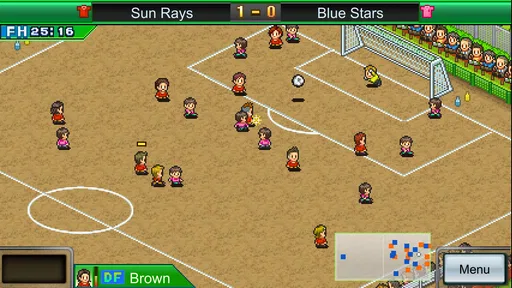
Visually, the game’s pixel art style is both charming and nostalgic. It adds a layer of whimsy that I found quite endearing. The animations are simple yet effective, and the interface is intuitive, making it easy for players of all ages to dive right in.
But don’t let the cute graphics fool you; this game is packed with depth. From setting up training schedules to managing sponsorships, there’s always something to do. The balance between managing off-field responsibilities and on-field tactics keeps the gameplay engaging and addictive.
Getting more from the management loop
My practical advice is to treat training, recruitment, and facilities as connected choices rather than separate chores. A new signing may look exciting, but a club also needs a plan for developing the players it already has. Before committing your attention to the next recruit, look at which parts of the squad are holding the team back and whether training or an upgrade is the more useful response. That habit makes the manager role feel deliberate instead of turning every session into a checklist.
Scouting is most rewarding when I have a specific need in mind. A promising player is not automatically the right answer if the rest of the team is underprepared, so I would use recruitment to address a weakness or give the squad a different option, not just to collect names. The trade-off is familiar to management games: each improvement competes for attention, and there is satisfaction in choosing what to postpone as much as in making a signing.
There is also a useful rhythm to the game’s different kinds of decisions. I can make a quick check of the club and leave the larger planning for a longer session, when I have time to think through player development and upcoming competition. For a realistic everyday use case, it fits a short break when I want to review the team, followed by a longer evening session when I feel like making changes and seeing how they affect results. It is less suitable if I need a game that delivers a complete, self-contained match in every brief visit.
Where it sits among sports games
Compared with a direct-control football game, this is for someone who enjoys being the person behind the squad rather than steering every player through a match. Its appeal is closer to a light club-management game: the satisfaction comes from recruitment, training, facilities, and the consequences of those choices. If your priority is lifelike presentation, granular modern tactics, or immediate control of the action, a dedicated football simulation is likely a better fit. If you like watching a plan take shape over time, the simplified visual style is part of the charm rather than a drawback.
That focus also explains who should skip it. Someone who does not enjoy menus, planning, or gradual improvement may find the management layer more like administration than play. Likewise, anyone expecting a current-season roster or a realistic broadcast-style match should look elsewhere. The pixel art and older release date are not problems in themselves, but they signal a particular kind of experience: approachable, stylized, and more interested in club progression than realism.
Engagement and Longevity
Pocket League Story is one of those games that you can easily pick up for a quick session or lose yourself in for hours. The progression system is satisfying, with each victory feeling like a well-deserved reward for all your hard work.
As you advance, you unlock new facilities and upgrades that not only improve your team’s performance but also enhance the overall gaming experience. I found myself constantly striving to upgrade my stadium and gym, knowing they would contribute to my team's success.
Who is likely to get the most from it?
I would recommend it first to players who enjoy a clear sense of ownership over a team: the squad is not just a collection of match statistics, but a project that develops through decisions about people and club resources. It also suits sports fans who are happy with a playful, pixelated look and would rather think about how to improve a side than demand a realistic recreation of professional football. Kairosoft’s familiar management-game sensibility is a good reason to consider it if you already like that style, though it is not a substitute for a full simulation.
For a parent choosing a game for a younger player, the Everyone rating is a helpful starting point. I would still consider whether that player likes planning and reading menus: an age rating does not guarantee that the management decisions will appeal to every child. For an adult, it can work as a low-pressure sports game to dip into between other activities, provided the gradual club-building is the attraction rather than a hurdle.
A common practical question is whether I need to know football tactics before starting. I would not treat specialist knowledge as a requirement; the more important thing is being willing to experiment with the players and options available. Another is whether the game is a good fit for very short play sessions. It can be picked up casually, but its deeper satisfaction comes from remembering what the club needs and following through on a plan, so interruptions may make it feel less absorbing than a quick arcade match.
Final Thoughts
Overall, Pocket League Story is a delightful blend of strategy, management, and charm. It’s perfect for soccer fans and anyone who enjoys games that require a bit of tactical thinking. Whether you’re a casual player or a hardcore strategist, this app has something to offer.
If you’re looking to add some soccer magic to your daily routine, give Pocket League Story a shot. It’s a small game with a big heart, and I’m sure you’ll find it as addictive and entertaining as I did. Happy managing!
My buy-or-skip call
I would pay for it if I wanted an approachable club-management game and felt comfortable spending $5.49 on that focused experience. I would skip it if I were shopping for free access, realistic match control, or the depth and contemporary presentation of a large football simulation. The choice is not really about whether it has a lot of things to manage; it does. It is about whether those small, connected decisions are the part of sports gaming I enjoy.
As a sports game, it has a distinct point of view: build a side, make choices for its future, and take satisfaction in seeing the work pay off. That makes it an easy recommendation for the right kind of player, but not a universal one. If the idea of guiding a pixel team from an uncertain start sounds more appealing than jumping straight into a match, I think the purchase makes sense.
Verdict
Strengths of Pocket League Story
- Engaging team management gameplay.
- Charming retro-style graphics.
- Intuitive controls for easy play.
- Variety of customization options.
- Addictive progression system.
Limitations of Pocket League Story
- Limited tutorial for beginners.
- In-game purchases can be pricey.
- Repetitive gameplay after a while.
- Occasional lag on older devices.
- AI difficulty spikes unexpectedly.
Other Releases by Kairosoft
View All
Game Dev Story
Simulation4.7

Hot Springs Story 2
Casual4.7

Grand Prix Story
Sports4.4

Basketball Club Story
Sports4.7
Similar Picks in This Category
View All
8 Ball Pool
Miniclip.com4.8

Pooking - Billiards City
AIM TOP GAME TECHNOLOGY LIMITED - pool4.6

Carrom Pool: Disc Game
Miniclip.com4.4

EA SPORTS FC Soccer Mobile 26
ELECTRONIC ARTS4.6

World Soccer League
mobirix4.3

Soccer Cup 2026: Football Game
INLOGIC SPORTS - football tennis golf soccer4.3
Frequently Asked Questions
What is Pocket League Story?
Pocket League Story is a simulation game where you manage a soccer team. Players take on the role of a manager, handling everything from training players to winning championships. The game, developed by Kairosoft, is known for its engaging gameplay and charming pixel art style, appealing to both casual and hardcore gamers.
How do I improve my team's performance in Pocket League Story?
Improving your team's performance involves training your players, hiring skilled coaches, and strategically planning matches. Players can also invest in better facilities and scout talented athletes. Balancing these elements is crucial for creating a successful team capable of winning tournaments and rising through the ranks.
Is Pocket League Story a free-to-play game?
Pocket League Story is a paid game on both Android and iOS platforms. It does not have in-app purchases, which means you get the full game experience without additional costs. This structure appeals to players who prefer a one-time payment for a complete game without microtransactions.
Can I play Pocket League Story offline?
Yes, Pocket League Story can be played offline. This makes it an excellent choice for gamers who enjoy playing on the go or in areas where internet connectivity is unreliable. Offline play ensures that you can manage your soccer team anytime and anywhere without needing a constant internet connection.
What are the system requirements for Pocket League Story?
Pocket League Story is compatible with most modern Android and iOS devices. It requires a minimum of Android 4.1 or iOS 9.0 to run smoothly. The game is designed to be lightweight, ensuring it performs well even on older devices, making it accessible to a wide range of users.
Play our best games!


